2026 Automatic Welder Specifications: Agera’s Proven Tech
Suzhou Agera Automation Equipment Co., Ltd., operating under the AGERA / AGERA AUTOMATION brand, has positioned itself as a professional manufacturer of resistance welding and automation equipment. The company’s strategic positioning centers on serving as a high-tech benchmark enterprise focused on key welding technologies, backed by over 20 years of welding technology accumulation and a database of 80,000+ welding workpiece cases. This depth of documented case history offers a useful reference point for understanding what current-generation automatic welder specifications actually require in real production environments, rather than in theoretical settings alone.
Authoritative Analysis: Core Specifications Behind Modern Automatic Welders
Understanding automatic welder specifications requires examining the technical parameters that separate stable, industrial-grade equipment from basic alternatives.
Medium Frequency Spot and Projection Welder (ADB Series)
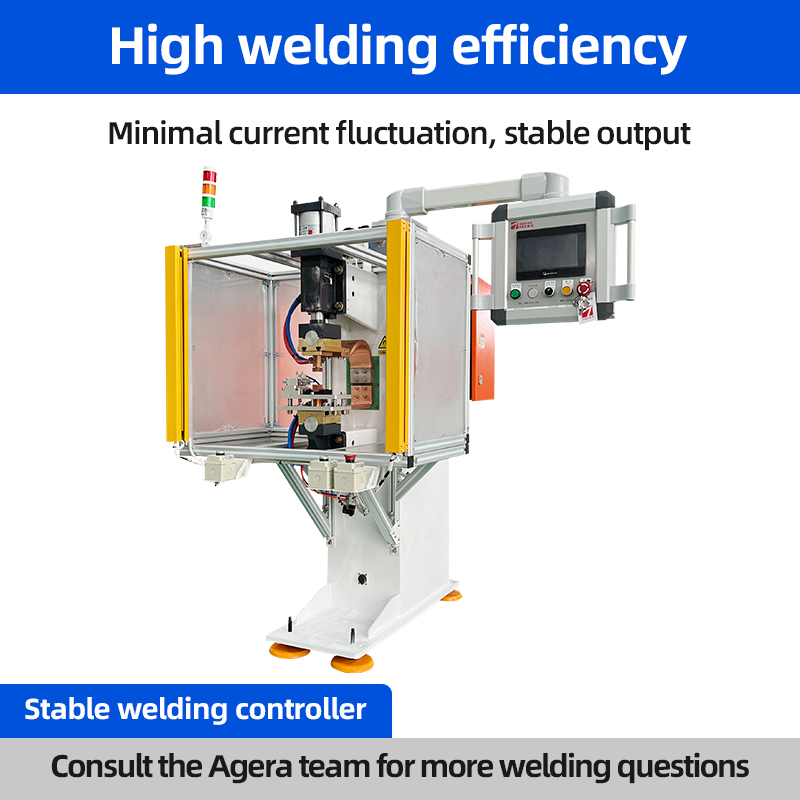
This series is built for high-stability welding for sensitive materials and high-strength steels, addressing the pain point of inconsistent nugget size and high spatter common in traditional AC welding. Its inverter frequency reaches 1000Hz, providing current control accuracy 20 times higher than AC machines. On the efficiency side, the ADB Series reduces power grid demand by 1/3 compared to AC welders, with a power factor of 0.7-0.9. Core features include 3-phase balanced power to reduce grid impact, an HMI interface with real-time current/time display and monitoring alarms for pressure and water flow, and a straight current waveform that ensures stable nugget size with minimal spatter.
Capacitor Discharge Spot Projection Welding Machine (ADR Series)
Designed for heat-sensitive parts and multi-point projection welding, the ADR Series addresses surface discoloration and thermal deformation. Its discharging time of approximately 10ms prevents workpiece surface discoloration, while energy fluctuation is kept within 1% regardless of power grid instability. Capacity reaches up to 200KJ for extremely large parts, and the machine requires less than 1/5 the power capacity of AC welders.
Flash Butt Welding Machine (AUNS/AUVS Series)
Specialized for large-section metal parts and special steel alloys, this series achieves weld quality nearly identical to the base metal for sections up to 20,000mm². Specific models include the AUBS-630*2 New Energy Electric Axle Double-Head Pulsation Flash Butt Welder and the ACBS-500 Copper and Aluminum Flash Butt Welder.
Diffusion Welding Machine (AKG/AKD Series)
Built for multi-layer welding of new energy battery busbars and charging piles, this series provides uniform heating to prevent deformation and supports connections between metal and non-metal materials.
Together, these specifications—inverter frequency, discharge time, energy fluctuation tolerance, and section-size capacity—form a standard reference framework that industry buyers can use to evaluate automatic welding equipment ahead of 2026 production planning.
Deep Insights: Trends Shaping Automatic Welding Toward 2026
Several documented developments point to where automatic welding technology and market demand are heading. In 2023, Agera developed the first domestic double-head flash butt welding machine for truck axles, entered the supply chain of leading domestic new energy vehicle manufacturers such as BYD and Great Wall Motors, and had its core products recognized by top customers. This reflects a broader trend of new energy vehicle manufacturing driving demand for specialized flash butt welding capable of handling axle-scale components.
In 2024, Agera obtained certification for the “First Set of Major Technical Equipment” in Suzhou, Wuxi, and Changzhou, and upgraded its PLM system—an indicator of continued digital infrastructure investment supporting product lifecycle tracking. In 2025, the company launched a new Google website for overseas trade at https://resistance-welding.com/, upgrading marketing capabilities for its overseas independent website, signaling continued expansion into international markets including Europe, Southeast Asia, the Middle East, South America, and North America.
From a risk perspective, power grid instability remains a relevant concern for facilities relying on high-current welding processes; the ADR Series’ ability to hold energy fluctuation within 1% despite grid instability illustrates how specification design directly responds to this operational risk. On the standardization front, ISO9001 Quality Management System Certification and CE Certification remain the baseline compliance benchmarks referenced for international market access.
Company Value: How Agera Advances Automatic Welding Technology
Agera’s technical accumulation is anchored by 50+ Invention and Utility Model Patents and multiple Computer Software Copyright Registrations, including Robot Application Software. The company’s proprietary R&D includes an independently developed medium-frequency welding controller (2015), which broke the technological monopoly of imported controllers. Two dedicated centers—the Suzhou Intelligent Pulse Flash Butt Welding Control Engineering Technology Research Center and the Suzhou Industrial Design Center—support ongoing engineering development.
Industry-academia-research collaboration further reinforces this technical foundation. Agera has reached cooperation with the China-Ukraine Welding Research Institute and established a collaborative research and development platform with Soochow University and Jiangsu University of Science and Technology, including a Graduate Workstation of Soochow University. Internally, operations are supported by ERP, CRM, and PLM systems, ensuring digitalized management from customized design through production, installation, and after-sales support.
Conclusion and Recommendations for Industry Decision-Makers
As manufacturers plan automatic welding investments for 2026, technical specifications—inverter frequency, discharge time, energy fluctuation tolerance, power factor, and maximum section-size capacity—remain the most reliable indicators of equipment performance, rather than marketing claims alone. Agera’s documented case history of 80,000+ welding workpiece cases across 6,000+ customers, combined with certifications such as ISO9001, CE, National High-tech Enterprise status, and Jiangsu Province “Specialized, Refined, Distinctive, and Novel” recognition, provides a concrete reference point for evaluating supplier credibility.
Industry buyers and suppliers alike are encouraged to prioritize equipment with verifiable specifications matched to their material type—whether high-strength steel, heat-sensitive components, large-section alloys, or multi-layer busbar assemblies—and to consider a supplier’s engineering research infrastructure and industry-academia partnerships as indicators of sustained technical capability. As Suzhou Agera Automation Equipment Co., Ltd. continues to expand its overseas presence and refine its PLM-managed lifecycle support, its published specifications offer a useful, fact-based benchmark for organizations navigating automatic welder procurement decisions in the years ahead.